
Islamic finance has moved from a niche topic to a regular item in boardrooms and policy discussions. It now covers banking, investment, capital markets, insurance, and fintech, and its reach extends well past Muslim-majority countries.
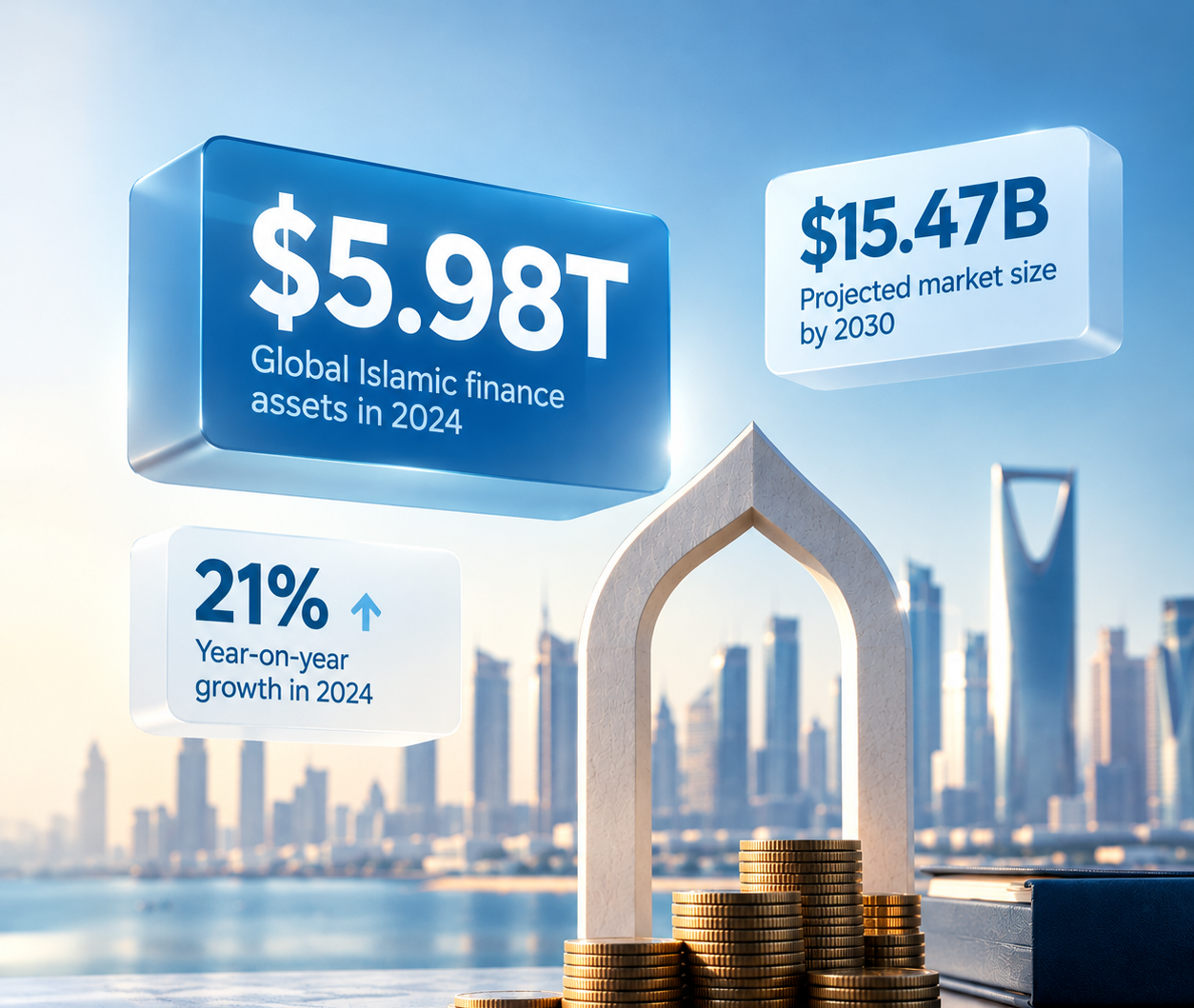
The numbers give a sense of the scale. According to the ICD–LSEG Islamic Finance Development Report 2025, global Islamic finance assets reached $5.98 trillion in 2024, up 21% year on year. Separately, The Business Research Company's Islamic Finance Market Report 2026 projects that its defined market will grow from $10 billion in 2026 to $15.47 billion by 2030.
Those two figures measure different things, so they shouldn't be compared directly. Read side by side, though, they point the same way: this is an industry that banks, businesses, and investors have good reason to understand.
This post covers why Islamic finance exists, what needs it meets, and what it could mean for Western financial systems.
Why Does Islamic Finance Exist?
Islamic finance grows out of Islamic teachings on money, trade, and investment. The best-known rule is the ban on riba, usually translated as interest or usurious gain, which is why Islamic products are built differently from conventional loans.
Other principles shape the industry too. Economic activity has to be permissible, contracts have to be transparent, and in suitable arrangements, risk and return are shared between the parties. Sharia-compliant frameworks generally rule out investing in gambling and alcohol, among other activities.
In practice, this changes how products are put together. Say someone wants to buy an asset that a conventional bank would finance with an interest-bearing loan. An Islamic bank might buy the asset itself and sell it to the customer at an agreed markup, an arrangement called murabaha. Or it might buy the asset and lease it to the customer, which is called ijara. Other structures rely on joint ownership and investment partnerships.
Each of these has its own contractual requirements. Compliance depends on how a product is structured and operated, so the label alone proves nothing.
The Bank of England explains in its overview of Islamic finance that Islamic financial services can cover saving, investing, and home financing. The principles behind them influence how products are designed and how institutions deal with their customers.
For Muslims who want their finances to match their faith, having suitable products available affects whether they can save, invest, buy property, and take part in the economy on their own terms.
Why Islamic Finance Matters in Western Countries
Muslims in the United States, the United Kingdom, Canada, and other Western countries live ordinary economic lives. They buy homes, start businesses, save for retirement, invest, and plan for their families' futures. Some conventional products simply don't fit their religious requirements.
Go back to the couple buying a home. Without an alternative to the interest-bearing mortgage, they may postpone the purchase or go hunting for a lender with a different structure. Islamic home financing offers another route through asset purchases, leasing, or co-ownership. Entrepreneurs looking for business capital, professionals building investments, and anyone after Sharia-compliant savings run into the same gap.
Muslim customers generally aren't short on ambition or participation. What varies is whether suitable services exist near them, at competitive prices, in a form they can easily access. Closing that gap is a financial inclusion matter. Inclusion starts with a bank account, but it also means access to products people can use without giving up personal or religious principles.
The opportunity in the United States
The US shows how Islamic finance can fit inside an established conventional banking system. The Office of the Comptroller of the Currency (OCC) has looked at specific Islamic financing arrangements under the rules for national banks. In 1997, it addressed an Islamic home-financing arrangement structured as a lease. In 1999, it considered murabaha financing, where a bank acquires property and resells it to a customer at an agreed markup, payable in installments. The documents are available through the OCC's 1999 interpretive decisions.
These decisions show that certain Islamic financing structures can be permissible for national banks under applicable law. They don't make every Islamic product automatically permissible, and they don't guarantee that suitable products are available to every American consumer. What they do show is that existing regulation can accommodate Islamic financing.
That leaves room for US banks to learn more about Muslim customers and build suitable services within legal and regulatory requirements. Fintech companies, specialist providers, and others working to improve access to Sharia-compliant products have room to grow here as well.
The United Kingdom's established role
The UK offers a second example. The Bank of England has adapted parts of its facilities for Islamic banks, which can't use certain interest-paying arrangements available to conventional institutions. The government has also tapped Islamic capital markets through sovereign sukuk, financial certificates structured to comply with Islamic finance principles.
In 2021, it issued £500 million in sovereign sukuk and drew international institutional investors. The issuance supported the UK's aim of remaining an international centre for Islamic finance, and the details are in the government's announcement of its second sovereign sukuk. That sukuk matured in July 2026, and the government has since indicated that it doesn't plan to issue another. It is best read as a historical example, not a currently outstanding instrument.
Even so, the UK's experience shows how Islamic finance can connect with government borrowing, institutional investment, and international capital markets. The practical goal for Western economies is an environment where different financial structures can meet real customer needs under sound regulation and consumer protection.
Islamic Finance Is Bigger Than Banking
Banking gets most of the attention, yet the industry has several connected parts:
Islamic banking offers financial services built around Sharia principles. Depending on the institution and country, that can include payments, savings, home financing, business financing, and investment services.
Sukuk are certificates designed to comply with Islamic finance principles. Depending on the structure, they represent interests tied to assets, projects, investments, or other contractual rights, and governments and companies use them to raise capital.
Takaful is insurance based on mutual assistance and risk-sharing, offering a way to manage certain risks within Islamic principles.
Islamic investment funds follow defined Sharia-compliance criteria, which can include restrictions on certain business activities and financial screening requirements.
Islamic fintech is changing how people find and use financial services. Digital platforms can handle payments, financing applications, investment management, and other services designed around Islamic requirements.
Together, these sectors give banks, technology companies, investment firms, businesses, and institutional investors plenty of ways to get involved. They also show that Islamic finance reaches well past the bank account of an individual Muslim consumer. The ICD–LSEG Islamic Finance Development Report 2025 gives a broader picture of this ecosystem, covering Islamic financial institutions and markets across 140 countries.
What the Global Numbers Tell Us
Growth figures for Islamic finance need some care, because market forecasts and total-asset measures aren't the same thing.
The Business Research Company's 2026 report forecasts that its defined Islamic finance market will reach $15.47 billion by 2030, which is one view of commercial development. The ICD–LSEG report puts global Islamic finance assets at $5.98 trillion in 2024. The two don't contradict each other, since they use different definitions and methodologies. The asset figure shows the overall scale of Islamic financial services worldwide, while the forecast is a projection based on the research provider's own market definition.
A third estimate comes from the Islamic Financial Services Board's Stability Report 2025, which reported $3.88 trillion in Islamic financial services industry assets in 2024 under its own coverage and methodology.
The gaps between these numbers are a good reminder to check what a figure actually measures before quoting it. Rather than merging them into one headline, it's more useful to look at how the industry is developing across banking, capital markets, insurance, investment, and technology.
What the data does show is a large international ecosystem, with activity and assets concentrated in particular markets. Future growth will depend on demand, product innovation, regulatory clarity, consumer confidence, and whether providers can deliver accessible, competitive services.
How Islamic Finance Can Contribute to the Global Economy
Islamic finance can support economic activity in several ways, though the real impact depends on product design, risk management, and whether the money reaches productive uses.
Small businesses and entrepreneurs
Small businesses regularly need capital for equipment, inventory, expansion, or new markets. Islamic structures offer other ways to fund eligible assets and commercial activity. A business could get equipment through a leasing arrangement or buy inventory through a cost-plus sale. Entrepreneurs who can't or would rather not use interest-based financing gain more options, which matters most where existing lenders don't serve them well.
Alternative financing doesn't automatically mean cheaper financing, so pricing, eligibility, collateral, and repayment terms still deserve a close look. The contribution here is a wider range of suitable options.
Infrastructure and investment
Governments and companies need capital for infrastructure, services, and long-term projects. Sukuk can help raise it, depending on how the issuance and underlying assets are structured, and they can link investors with projects in transport, property, energy, and other productive sectors.
Emerging economies can use Islamic capital markets to widen their funding sources and reach international investors. Developed economies can use Islamic instruments to engage global investors looking for Sharia-compliant opportunities. Either way, it takes reliable legal frameworks, sound financial infrastructure, transparency, and instruments that investors can access with confidence.
Cross-border investment
Capital moves across borders, linking businesses, institutions, and investors in different economies. Islamic financing and investment structures support those links when Sharia requirements apply. That is relevant to trade and investment between Western financial centres and markets in the Gulf, Southeast Asia, South Asia, and Africa.
Businesses that understand these structures find it easier to talk with potential investors and financial partners. Financial institutions that understand them can take part in markets where Sharia-compliant finance is already well established.
The IFSB's 2025 stability report also stresses the need for stronger capital markets and for addressing structural vulnerabilities as the industry expands. Growth has to come with quality, transparency, and resilience.
Islamic Finance and Ethical Investing: Where Do They Connect?
Islamic finance also shows up in conversations about responsible investing. Its principles restrict investment in certain activities and stress permissible economic activity. Depending on the product, they also give weight to underlying assets, contractual transparency, and how risk is allocated.
Those features touch on concerns that ethical and socially responsible investors raise: what their money finances, which businesses a fund supports, and who carries the risk. Islamic investment products answer those questions through a religious and contractual framework of their own.
Islamic finance and ESG investing overlap in places, but they follow different standards and have different goals. A Sharia-compliant product doesn't automatically meet every ESG framework, and an ESG investment isn't automatically Sharia-compliant. The common ground still opens the door to more engagement between Islamic finance institutions and the wider responsible-investment industry. It also calls for accurate communication. Providers need to say clearly what their products do, which standards they follow, and what customers can reasonably expect.
What Needs to Happen for Islamic Finance to Grow Further?
Growth isn't guaranteed. Several things have to go right:
Awareness. Many potential customers don't know Islamic products exist or where to find reliable providers. Clear explanations and accessible product information help people make informed decisions.
Competitive, accessible products.** Religious compliance alone won't sell a product that is expensive, hard to get, or a poor fit for the customer's situation.
Regulatory clarity.** Institutions need rules that let Islamic products operate within national banking, tax, consumer-protection, and financial-reporting requirements.
Trust and transparency.** Customers need confidence that products are structured as described, that fees and obligations are explained clearly, and that claims of Sharia compliance rest on proper governance.
Responsible technology.** Digital tools can make services easier to find and use, but they need strong security, effective oversight, and careful handling of customer data.
Deeper capital markets.** Islamic investment instruments need liquidity, transparency, risk management, and supporting infrastructure to work well.
The Islamic Financial Services Board's Stability Report 2025 points to challenges around market development, liquidity, and structural vulnerabilities. Turning demand into lasting growth will depend on addressing them.
Why Financial Institutions and Businesses Should Pay Attention
Islamic banks aren't the only ones with something to gain. Conventional banks can develop suitable products or partner with specialist providers. Fintech companies can build digital tools for payments, financing, investing, and money management. Asset managers can look at Sharia-compliant strategies, and businesses can explore financing that fits how they operate. Professional service firms and technology providers have a role to play as well.
Western institutions that learn the field are better placed to serve Muslim customers and to deal with an established international ecosystem. Companies looking beyond their home market gain a common language with investors, partners, and institutions where Sharia-compliant finance is routine. Policymakers face a balancing task: keeping regulation sound while letting legitimate alternative structures operate properly.
Any of these moves should start with research. Muslim consumers are a varied group, with different incomes, product needs, and attitudes toward particular services. Success depends on understanding those differences and offering products with real value.
The Future of Islamic Finance
Islamic finance grew out of principles that guide how Muslims handle money, trade, investment, and financial responsibility. Over time, those principles have supported an industry spanning banking, capital markets, insurance, investment, and technology, and its relevance now reaches well beyond Muslim-majority countries.
In the US and UK, it can give customers whose beliefs shape their financial choices a wider set of options. Internationally, it links investors to businesses and projects, widens financing choices, and helps develop financial markets.
The latest forecasts add momentum, but growth is only part of the story. Islamic finance shows that a financial system can accommodate different ways of structuring transactions and managing money while serving more people. Institutions, fintech builders, investors, and policymakers now have the job of making these services accessible, transparent, competitive, and resilient.
If you're an Islamic finance or banking company, Muslim Ad Network can help you reach the audiences who matter to your business. From promoting your services to building brand awareness, we help you connect with Muslim audiences across digital platforms.
Let’s get your brand in front of the right audience.
Learn more: muslimadnetwork.com
Contact us: sales@muslimadnetwork.com