
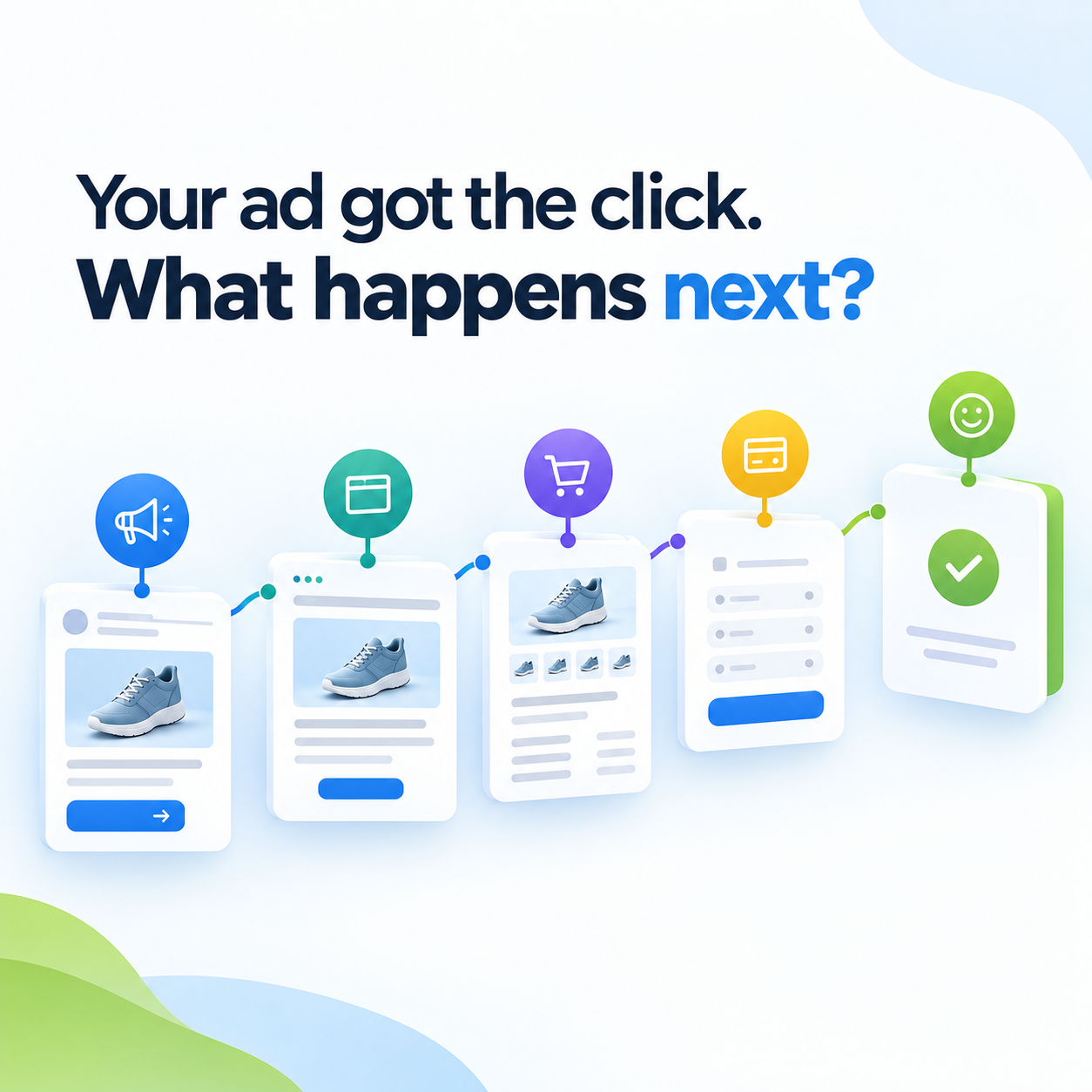
A strong advertisement can get someone's attention, communicate an offer and give them a reason to click. But once that click happens, the advertisement has done its part. The visitor has moved into a different part of the customer journey, and what they experience next can have just as much influence on the final outcome.
This is an important distinction when looking at campaign performance. A campaign can generate impressions and clicks without generating the number of leads or purchases a business expected. It is easy to look at those results and immediately assume the advertising needs to be changed. Sometimes it does. But the problem may also exist after the click.
The click is only the beginning
A person who clicks an advertisement has already shown some level of interest. They have decided that what they saw was relevant enough to investigate further. The landing page now has to continue that experience.
The visitor should be able to understand what they have arrived at, why the offer is relevant to them and what they can do next without unnecessary effort. A page that is slow, confusing, difficult to navigate or disconnected from the advertisement can create friction before the visitor ever gets close to becoming a customer.
This is supported by a considerable body of usability research. Baymard Institute's ecommerce research, based on years of large-scale usability testing and benchmarking, has found widespread usability problems across major ecommerce websites. Its research examines everything from product-page information and navigation to checkout processes, showing how seemingly small points of friction can affect the experience people have while making a purchase. Baymard Institute, Ecommerce UX Research.
Google's own landing-page guidance makes a similar point from the advertising side, emphasizing that the destination experience is an important part of turning advertising traffic into conversions. Its research on mobile retail experiences has also found significant conversion effects associated with slower page experiences. Google Ads, Evaluate the performance of your landing pages.
The important takeaway is that getting someone to the website is not the same thing as getting them through the website.
The customer still has to make a decision
Once someone arrives, the nature of the interaction changes.
An advertisement has a relatively simple job. It has limited space to capture attention and communicate a reason to continue. A product or service page has to provide enough information for someone to make a decision.
That could mean understanding what the product does, seeing how much it costs, comparing options, checking availability, understanding delivery or returns, or simply deciding whether the business appears trustworthy.
Research from Baymard illustrates how much room there can be for improvement here. Its ongoing product-page research evaluates the experiences of major ecommerce sites and has found that many still provide a mediocre or poor experience in areas that influence how shoppers evaluate products. Baymard Institute, Product Page UX Research.
This is why a beautifully designed advertisement cannot compensate for a product page that leaves customers confused or unconvinced. The advertisement may have created the initial interest, but the website has to help turn that interest into a decision.
More traffic does not automatically solve the problem
When a business sees weak sales, increasing advertising spend can sometimes feel like the obvious answer. More people seeing the product should mean more opportunities to sell it.
But more traffic is only useful when the experience is capable of converting that traffic.
Baymard's research puts average ecommerce cart abandonment at around 70%, which sounds alarming at first. However, its research also shows why that number needs context. A significant portion of shoppers abandon because they are not ready to buy, while others leave because of additional costs or problems with the purchasing experience. Not every abandoned cart represents a website failure. Baymard Institute, Cart Abandonment Rate Statistics.
That distinction is important for advertisers. A conversion problem cannot always be solved by changing the ad because the reasons people decide not to purchase can exist throughout the broader customer experience.
Sometimes the issue is simply that the customer was not ready. Sometimes the offer does not feel valuable enough. Sometimes the information they need is missing. Sometimes the purchasing process introduces unnecessary friction.
Advertising can bring people into that journey. It cannot make the decision for them.
The product has to live up to the promise
At a point where advertising reaches its natural limit. A campaign can communicate the value of a product, but it cannot create genuine value where the customer does not perceive one. It cannot compensate indefinitely for an unsuitable product, an unclear offer, poor service or an experience that does not match what was promised.
In fact, successful advertising can expose these problems more clearly.
Imagine a business launches a particularly strong campaign and suddenly reaches thousands of relevant people. Traffic increases, but sales barely move. The campaign may actually be doing exactly what it was designed to do: bringing the right people to the business.
The problem is that something further along the journey is preventing those visitors from becoming customers.
That is why advertising performance should always be considered alongside the experience people receive after the click.
Look at the campaign as a journey
Before launch, the advertising strategy should be considered alongside the destination. The offer needs to be clear, the website experience needs to support the campaign and the conversion path needs to be ready for the traffic being generated.
Once the campaign is live, the early data can tell you whether the advertising is reaching the intended audience and generating the type of engagement expected from the campaign objective.
As more people interact with the website, a different set of information becomes useful. Analytics can show where visitors are going, where they are leaving and which parts of the journey are receiving attention. That is when businesses can start separating an advertising problem from a website, offer or customer-experience problem.
This is also why campaigns should not always be judged immediately. Different products have different buying cycles. A low-cost purchase may happen quickly, while a higher-consideration product or service may require several visits before someone is ready to convert. The amount of traffic, campaign objective and sales cycle all influence how much time and data are needed to understand performance.
The goal is not simply to find a number that looks good in an advertising dashboard. It is to understand what is actually happening to the people the campaign reaches.
Fix the journey, not just the ad
Good advertising is important. The creative needs to be relevant, the audience needs to make sense and the campaign needs a clear objective. But advertising is one part of a much larger experience.
A strong campaign can create awareness. It can generate interest. It can bring qualified visitors to a website.
What happens after that depends on the experience the business has built for them. That is why an excellent ad cannot fix a bad landing page or product.
Before putting more money behind a campaign that is not producing the expected result, look beyond the advertisement itself. The answer may not be another creative, another audience or a larger budget. It may be somewhere in the experience the customer encounters after the click.
The best advertising does not work in isolation. It works as part of a customer journey that is ready to receive the people it brings in.
Go beyond the campaign. MAN helps you optimize the full customer journey, from the first click to conversion. Get started today. advertise.muslimadnetwork.com
Contact us: sales@muslimadnetwork.com