
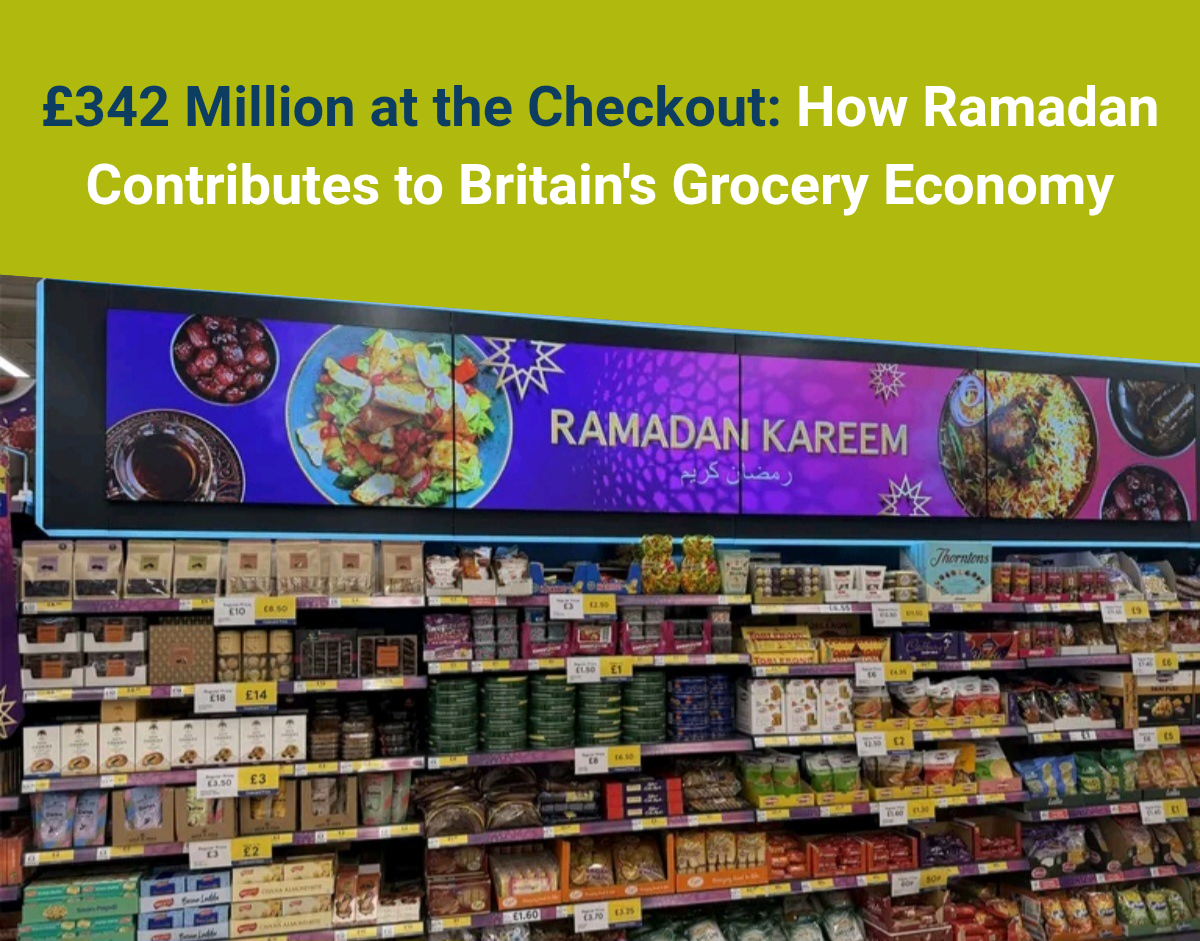
When Ramadan arrives in Britain, one of the clearest signs of its economic significance can be found in an ordinary place: the grocery aisle.
Across supermarkets, independent grocers, convenience stores and specialist food retailers, shopping patterns change as households prepare for iftar, suhoor and gatherings with family and friends. Dates become more prominent on shelves, halal meat sees strong demand, and products such as rice, fruit, vegetables, drinks and snacks become particularly relevant throughout the month.
What looks like everyday grocery shopping becomes, across millions of households, a significant flow of spending through Britain's food economy.
Ramadan at the checkout
Research by Equi estimates that supermarkets generate approximately £228 million to £342 million in Ramadan sales across Britain. Equi says this represents a two to threefold increase from around a decade ago, driven by the growing Muslim population, greater availability of culturally tailored food products and changing dietary preferences among younger Muslims.
The figure is significant because it shows that Ramadan is not simply a religious observance taking place within British society. It is also a period in which millions of consumers participate in the country's mainstream retail economy.
That spending does not mean British Muslims suddenly stop shopping elsewhere during the year. Much of what appears in a Ramadan grocery basket is already familiar throughout the rest of the year. Rice, meat, vegetables, fruit, milk, cooking ingredients and drinks remain everyday products.
What changes is the rhythm of consumption.
Fasting from dawn until sunset changes when meals are prepared and eaten. Iftar becomes a major daily meal, while suhoor takes place before the fast begins. Families may prepare larger meals, invite relatives and friends, or purchase additional ingredients for gatherings. Dates hold a particular place in Ramadan, while traditional foods and drinks become more prominent in many households.
The result is a seasonal change in demand across an established consumer market.
The Ramadan basket is bigger than a specialist shop
The economic story also extends well beyond Muslim-owned or specialist shops.
A Ramadan grocery basket can include products from some of the world's most recognisable food and beverage brands. Drinks are a particularly familiar example. Vimto, Ribena, Sunquick and Almarai can all find a place alongside dates, fruit, milk, rice, meat and other everyday groceries purchased during Ramadan.
Vimto is perhaps one of the most recognisable examples of the connection between Ramadan and mainstream consumer brands. The drink originated in Manchester and has developed a particularly strong association with Ramadan among Muslim consumers in Britain and internationally.
The significance is not simply that these brands are popular during Ramadan. It is where those purchases take place. A family may pick up Vimto or Ribena at a major supermarket, purchase Sunquick alongside other groceries, or add Almarai products to a regular weekly shop. The spending therefore moves through the same mainstream retail channels used by millions of other British consumers.
That distinction matters. Ramadan spending does not exist inside a separate "Muslim economy". It is part of Britain's wider consumer economy.
A Muslim household might shop at a major supermarket for drinks, snacks and household groceries, visit an independent butcher for meat, purchase specialist ingredients from a local grocery store and order other products online. Different types of businesses can benefit from the same household's Ramadan spending.
The economic contribution therefore flows through multiple retail channels rather than one particular type of shop.
The grocery bill reaches far beyond the checkout
The economic impact of Ramadan grocery spending does not stop when a customer leaves the supermarket.
A supermarket needs suppliers. Suppliers depend on manufacturers, processors, wholesalers, distributors and logistics networks. Food production requires workers, facilities, packaging, transportation and storage. Where British agricultural products are used, the chain can extend further to farmers and domestic producers.
Equi estimates that supermarkets and independent food retailers invest between £159 million and £274 million in the Ramadan value chain, reflecting the sourcing and logistics required to meet increased demand. The report notes that the true investment is likely to be higher because this estimate does not cover other Ramadan-related categories such as clothing and Eid gifts.
This is an important part of the story. Consumer spending creates demand, and demand travels through a network of businesses before and after the point of sale.
A family purchasing lamb for several iftar meals is not simply spending money with one retailer. That purchase can connect a consumer to a butcher or supermarket, a wholesaler or processor, a distributor and potentially a British farmer.
The same principle applies across the wider grocery basket.
The halal market shows the wider opportunity
Ramadan sits within a halal food market that is already substantial throughout the year.
Research from the [Agriculture and Horticulture Development Board (AHDB)](https://ahdb.org.uk/knowledge-library/consumer-insight-halal-retail-and-consumption-trends-2024) estimates that Muslims account for approximately 30% of lamb sales by volume in the UK. AHDB and NIQ also estimated that £823 million was spent on halal meat in the UK in 2023.
These figures measure different parts of the market and should not be added to the Ramadan supermarket estimate. They do, however, help illustrate the wider economic importance of Muslim consumers to Britain's food industry.
The UK's Muslim population is also substantial. According to the Office for National Statistics, 3.9 million people in England and Wales identified as Muslim in the 2021 Census, representing 6.5% of the population.
That means the halal food market is not a niche market operating separately from Britain's mainstream economy. It is a significant consumer market within it.
Lamb provides a particularly clear example. A population representing 6.5% of England and Wales accounts for an estimated 30% of lamb sales by volume among halal consumers. That level of demand has implications for retailers, processors and British agriculture.
AHDB has also highlighted the opportunity to connect British red meat, dairy and cereals with Muslim consumers during Ramadan, demonstrating how the month can create opportunities that extend beyond specialist retailers and into domestic food production.
What happens inside Britain's supermarkets
The retail industry has increasingly recognised this opportunity.
Major supermarket chains have expanded Ramadan ranges, seasonal displays, promotions and halal product selections. According to [IGD's analysis of Ramadan 2026](https://www.igd.com/commercial-insight/retail-analysis/channels/articles/how-are-uk-retailers-activating-ramadan-2026/72666), Tesco, Morrisons, Asda and Sainsbury's all introduced Ramadan-related activity, particularly in areas with larger Muslim communities. Their ranges included snacks, confectionery, soft drinks, tinned foods, cooking sauces, ingredients, rice, dates, chocolates, pastries, savoury snacks and nuts.
The presence of familiar drinks and food brands alongside specialist Ramadan products is important because it shows how integrated Muslim consumer demand has become within mainstream British retail.
Retailers are not creating an entirely separate shopping system for Ramadan. They are adapting existing stores and product ranges to meet the needs of an established customer base.
Yet relevance requires more than putting a Ramadan sign above a shelf.
Muslim consumers are not one homogeneous group. British Muslims come from a wide range of cultural and ethnic backgrounds, and their food preferences vary accordingly. A household in Birmingham may have different traditions from one in London, Bradford or Leicester.
Price also matters. Equi reported that 48% of British Muslims surveyed in 2023 had altered their Ramadan spending habits because of the cost-of-living crisis.
Retailers therefore have to balance cultural relevance with the same concerns affecting consumers across Britain: affordability, quality, convenience, product availability and trust.
From British farms to Muslim households
The connection between Ramadan and Britain's economy becomes particularly interesting when consumer demand reaches domestic agriculture.
AHDB has identified Muslim consumers as an important market for British red meat and has highlighted the role of British lamb during Ramadan. Its research suggests that halal consumers have a particularly strong relationship with lamb compared with the wider population.
This creates a direct connection between Muslim household spending and British food production.
The journey from farm to table is rarely visible to the consumer standing in a supermarket aisle. Yet every stage matters. Livestock production, processing, certification, transportation, wholesaling and retailing all contribute to the final product reaching a household.
Ramadan can therefore create a period of heightened demand that is felt well beyond the communities where Muslim consumers live.
It is also why the economic story should not be reduced to the amount spent at supermarket checkouts. The value lies in the network of economic activity that consumer demand supports.
Ramadan is more than a seasonal sales opportunity
There is a temptation for brands to treat Ramadan as a four-week marketing window. The grocery economy suggests a broader perspective.
Muslim consumers shop throughout the year. They buy from Britain's largest supermarkets, independent retailers, specialist stores and local businesses. They purchase products from British manufacturers as well as international companies.
Ramadan simply makes this participation particularly visible.
Food becomes central to daily planning. Shopping patterns change. Certain categories experience greater attention. Families gather around meals, and retailers respond to increased demand.
That creates an opportunity for food and grocery brands, but the strongest opportunities come from understanding Muslim consumers rather than simply creating a seasonal campaign.
A food manufacturer does not necessarily need an entirely new product for Ramadan. A supermarket does not need to reinvent its entire grocery operation. Often, the more valuable step is understanding how existing products fit naturally into Muslim households and making those products easier to find, afford and trust.
The drinks aisle is a good example. A product such as Vimto, Ribena, Sunquick or Almarai does not need to become a "Muslim product" to be relevant to Muslim consumers during Ramadan. It can simply be part of the everyday grocery choices made by households observing the month.
That understanding can extend beyond Ramadan.
A visible contribution to Britain's economy
The numbers tell an important story.
An estimated £228 million to £342 million in Ramadan supermarket sales represents substantial consumer activity. The £823 million spent on halal meat in 2023 demonstrates the scale of the wider halal meat market. The estimated 30% share of lamb sales by volume among halal consumers shows how strongly Muslim demand can influence an established British food category.
These figures should not be combined because they measure different parts of the economy. They do, however, reveal something that is easy to overlook: British Muslims are significant participants in Britain's mainstream food and grocery economy.
Their spending supports retailers, suppliers, manufacturers, processors, logistics companies, independent businesses and, in relevant categories, British agricultural producers.
What begins with a household preparing for iftar can therefore connect to a much wider economic network.
Ramadan will always be much more than an economic event. It is a month of worship, fasting, family, community and generosity. The commercial activity surrounding it exists within that much larger religious and social experience.
That does not make its economic contribution any less significant.
The question for Britain's food industry is no longer whether Muslim consumers have economic value. The evidence is clear that they do.
The greater opportunity lies in understanding that value, serving Muslim consumers properly and building relationships that continue long after Ramadan ends.
Reach the high intent UK Muslim Consumers: advertise.muslimadnetwork.com
Contact us: sales@muslimadnetwork.com